Article overview
Which platform fits?Shopify, SHOPLINE and Boutir suit different needs; compare storefront, social-selling and retail workflows.What matters for Hong Kong payments?Distinguish native, third-party and manual payments, and account separately for processor and applicable platform fees.Design, retail and deliveryAll three support store operations; retail, delivery and cross-border capabilities depend on the plan and integrations.Choosing the right online store platform in Hong Kong starts with understanding your operational priorities. Shopify is a strong option for brands seeking bespoke storefront design, an extensive global app ecosystem, and streamlined multi-market international expansion. SHOPLINE is designed for merchants focused heavily on the Hong Kong local market, native logistics and payment integrations, social commerce, and connected retail (OMO). Boutir is well-suited for entrepreneurs and boutique sellers who prefer mobile-first store management and straightforward local social selling.
While all three enable you to sell online, their maintenance overheads, transaction fee models, and scalability differ significantly:
- Shopify offers a wide choice of themes and development options, but accepting local payments like PayMe and FPS requires a third-party gateway and may incur plan-dependent platform fees. In-person card payments use an external terminal; POS orders are exempt from Shopify third-party transaction fees.
- SHOPLINE bundles local payment, logistics, and social tools into a unified Hong Kong offering, but plan upgrades, add-ons, and monthly traffic maintenance fees directly impact ongoing expenses.
- Boutir excels in mobile convenience and includes mPOS on higher tiers, but offers fewer options for deep theme customization, enterprise ERP connectivity, or multi-currency international commerce.
This comprehensive evaluation by the Navy FAB eCommerce team compares pricing, payments, retail features, and migration considerations across all three platforms.
Plan prices and features were verified against official provider materials on 8 November 2026.
Shopify, SHOPLINE and Boutir at a glance
The table below outlines starting configurations for Hong Kong merchants, based on publicly available entry plans (Shopify Plus is an enterprise-tier offering evaluated separately):
| What matters | Shopify | SHOPLINE | Boutir |
|---|---|---|---|
| Best fit | Brands that value storefront design, app choice and the ability to sell across markets. | Merchants combining a Hong Kong webstore, social selling and, on the OMO plan, physical retail. | Teams that prefer mobile-led management, with an option to connect online and shop sales. |
| Annual subscription | Basic: HK$2,748/year, equivalent to HK$229/month. | Basic: HK$5,988/year, equivalent to HK$499/month. | Essential: HK$4,488/year, equivalent to HK$374/month. |
| Monthly subscription | Basic: HK$259/month, billed monthly. | The Basic page also lists an original price of HK$555/month, but does not say whether it can be paid month to month. | The provider's comparison page does not state a monthly-billed Essential price. |
| Extra charges | Card processing and applicable third-party transaction fees are additional, as are paid themes, apps and development. | Basic lists a 0.8% monthly traffic maintenance fee; payment processing and add-ons are separate. Exemptions vary by plan. | Payment methods have their own processing charges; optional services such as a branded app can add costs. |
| Day-to-day management | Manage products and orders on web or mobile; Basic allows unlimited products but no additional staff accounts. | Basic lists 1,000 products, 100 product specifications or variants and five admin accounts. Pro, Social Pro and OMO list unlimited products and 400 specifications or variants; the first two allow five admin accounts each, while OMO lists unlimited accounts. Order splitting is listed; order merging and fulfilment splitting are separate add-ons. | Manage the store on mobile or desktop; Advanced adds order editing, split shipments and merged orders. The public material does not specify product or admin-account limits. |
| Store design | Choose a theme and customise it in the editor; paid themes and custom development are options. | Drag-and-drop design tools and templates; CSS editing is listed in the plan comparison. | Advanced advertises more than 20 templates and custom pages, managed without coding. |
| Hong Kong payments | Shopify Payments handles eligible online card and accelerated-checkout methods; local wallets may require activation or a separate payment provider. | SHOPLINE Payments lists cards and FPS among its methods; the plan page separately lists third-party PayMe for Business integration. | Published Hong Kong payment materials list card, wallet and manual-transfer options; the workflow varies by provider. |
| Physical retail | Shopify POS can manage retail alongside the store, but in-person card payments in Hong Kong require an external terminal and third-party processor. | The All-in-one OMO plan includes POS retail functions and online/offline member-data synchronisation. | Advanced advertises mobile POS for a phone or tablet, with online/offline orders, stock and customer information. |
| Delivery | Connect to SF Express, cold chain, and pickup points using apps such as ShipAny. | OneShip connects SF Express, cold chain, Kerry, Hongkong Post; pickup from store stock requires POS. | Official features list SF Express (sender-paid, receiver-paid, cold chain), Hongkong Post, ZTO, and alfred24 lockers; ShipAny integration is also supported. |
| Languages and currencies | Basic, Grow and Advanced support up to 20 published languages with compatible themes and translations. Local-currency checkout requires Shopify Payments or Adyen. | Supports language selection and currency display. Its help guide describes converted prices as a reference, with the order processed in the store's configured currency. | The public materials reviewed do not establish current language and foreign-currency checkout limits for each Hong Kong plan. |
| Apps and extensions | Shopify App Store covers functions such as email, loyalty and subscriptions; each app has its own cost and data permissions. | Offers add-on modules and third-party integrations alongside built-in social and retail tools. | Advanced includes tools such as loyalty points and mobile POS; the scope of additional third-party apps depends on the service. |
| APIs and integrations | GraphQL Admin API supports authorised access to store data; a custom ERP connection still needs development and maintenance. | Existing third-party connections use integration credentials; OpenAPI access is plan- or add-on-dependent. | The current public materials reviewed do not give enough detail to compare API permissions or limits. |
| Data export | Products can be exported as CSV, but the image files themselves are not included in that CSV. Customer passwords cannot be migrated by customer CSV. | Product and order exports are documented; available fields differ by report. | Confirm the export format and available product, order and customer fields for the selected plan before relying on a migration schedule. |
| Help and support | The Hong Kong plan page lists 24/7 chat support, with service levels varying by plan. | The Basic plan lists 24-hour customer service; specialist modules and providers may have separate support arrangements. | The provider describes support for its store and mPOS products; check the support hours and channel included in your agreement. |
Annual figures represent the monthly equivalent of prepaid annual billing. For stores requiring higher capacity and advanced capabilities, higher-tier published plan pricing includes:
- Shopify: Grow is HK$7,788/year (HK$649/month equivalent), or HK$719 billed monthly; Advanced is HK$33,480/year (HK$2,790/month equivalent), or HK$3,090 billed monthly. Plus represents enterprise tier: standard setups start at US$2,300/month on a three-year term or US$2,500/month on a one-year term, with negotiated card rates and custom checkout logic for high-volume brands.
- SHOPLINE: Pro is HK$14,799/year (about HK$1,233.25/month); Social Pro is HK$19,988/year (about HK$1,665.67/month); OMO is HK$26,988/year (HK$2,249/month). Pro and higher plans qualify for a waiver of monthly traffic maintenance fees on transactions processed through SHOPLINE Payments.
- Boutir: Advanced is HK$11,888/year (about HK$990.67/month) and V-Commerce is HK$18,888/year (HK$1,574/month).
Sources: Shopify Hong Kong pricing, SHOPLINE Hong Kong plans, Boutir plan comparison and Boutir Advanced.
Hong Kong payments: what happens at checkout?
When setting up payments in Hong Kong, displaying a payment logo at checkout does not tell you the whole story regarding processor fees, reconciliation, and settlement timing. Payment setups generally fall into three distinct models:
- Native platform payment services. Eligible Hong Kong Shopify merchants can activate Shopify Payments to accept Visa, Mastercard, AMEX, Apple Pay, and Google Pay with no Shopify third-party transaction fee on payments processed by Shopify Payments. For stores created on or after 12 May 2025, third-party transaction fees may apply to amounts paid with store credit or gift cards. Alipay and WeChat Pay are also supported under early access depending on merchant account standing. SHOPLINE offers its proprietary SHOPLINE Payments for cards and FPS.
- Third-party payment gateways. For automated local digital wallets (such as PayMe and FPS), merchants connect external processors such as Airwallex or QFPay. In this setup, merchants pay the processor's transaction rate, and on Shopify, an additional plan-dependent third-party transaction fee applies (Basic 2%, Grow 1%, Advanced 0.6%). Manual bank transfers and POS sales are explicitly exempt from this Shopify fee.
- Manual offline payments. Customers transfer funds via ATM, online banking, or personal wallet and upload a receipt. Merchants verify the deposit manually and mark the order as paid. Shopify charges no platform transaction fees on manual orders, making it viable for brand-new or low-volume shops, though it incurs significant administrative overhead.
PayMe and FPS on Shopify
Hong Kong Shopify stores looking to automate PayMe and FPS checkout typically integrate via Airwallex or QFPay:
Airwallex Online Payments supports automated FPS checkout via dynamic QR codes. Shoppers scan the displayed code using their mobile banking app, and the order status updates automatically from Pending Payment to Paid upon confirmation. However, please note: Airwallex has temporarily paused onboarding for new PayMe merchant applications as of late 2026. Stores with PayMe already activated can continue processing transactions, but new stores should not assume immediate PayMe availability via Airwallex.
Merchants manage transactions under Payments → Payment activity in Airwallex and reconcile payouts using the Settlement Report. Note that "Paid" status indicates successful payment authorization; funds settle to your bank account according to your agreed payout schedule. Airwallex recommends initiating customer refunds directly from the Shopify admin to maintain synchronization across platforms. See Airwallex FPS documentation, Airwallex payment records, and Airwallex Shopify setup guide.
QFPay is another established payment provider for Hong Kong Shopify stores, supporting PayMe, FPS, AlipayHK, and WeChat Pay. Depending on the device and approved payment method, shoppers may be directed to the relevant wallet app to authorise payment. Once approved, merchants install QFPay's dedicated Shopify app, and activate the approved payment methods. Merchants can check transactions in QFPay and, when the wallet and refund criteria permit, initiate refunds from Shopify. See QFPay Shopify checkout and QFPay FAQ.
What about SHOPLINE and Boutir?
SHOPLINE's Hong Kong plan page lists FPS under SHOPLINE Payments and provides a separate integration for HSBC PayMe for Business. While PayMe under SHOPLINE Payments is listed as coming soon, merchants can connect a commercial HSBC PayMe for Business account using API credentials. Desktop shoppers scan a PayCode, while mobile shoppers are seamlessly redirected to the PayMe app. SHOPLINE also supports direct HSBC Business Collect FPS connectivity.
Boutir supports both manual transfers (where customers upload payment receipts for manual verification) and automated commercial gateways via HSBC PayMe for Business and Business Collect. For smaller boutique shops, manual collection requires staff to reconcile payments; commercial gateways offer a different workflow and have their own eligibility and fees.
Keep processing fees and platform fees separate
On Shopify, external gateways incur a third-party transaction fee of 2% on Basic, 1% on Grow, and 0.6% on Advanced, charged in addition to the payment provider's processing rate. Activating Shopify Payments does not automatically waive transaction fees on external gateways like Airwallex. However, manual payments, in-person POS transactions, and PayPal (when Shopify Payments is the primary processor) qualify for documented exemptions. See Shopify transaction-fee terms.
On SHOPLINE, plans include a monthly traffic maintenance fee (e.g. 0.8% on Basic), which is waived on Pro, Social Pro, and OMO plans when using SHOPLINE Payments. Payment processing fees remain separate under both platforms.
For a detailed financial breakdown of subscriptions, transaction fees, apps, and setup investments, see our Shopify Hong Kong pricing and fees guide.
Design, retail and delivery: where the differences matter
Store design and staff time
All three platforms offer templates and customization capabilities, but their ongoing maintenance philosophies differ. Shopify gives brands full control over visual identity, modular theme sections, and custom Liquid development. SHOPLINE integrates drag-and-drop page building with live social commerce tools in a single dashboard. Boutir's mobile-first interface allows store owners to update products and handle promotions entirely from a smartphone.
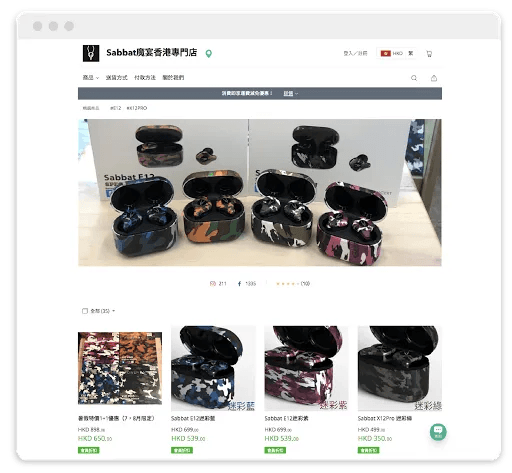
The historical storefront images below are retained from an earlier version of this article. They illustrate design choices rather than the current interface or features of a particular plan.


POS and fulfilment
For physical retailers in Hong Kong, Shopify POS manages unified inventory and orders. Staff can use the camera on a mobile device to scan barcodes for rapid checkout; with Quick count enabled, staff can also scan barcodes to adjust inventory quantities on the go. For structured inventory cycle counts requiring administrative review and approval, stores require POS Pro and must initiate the session within the Shopify admin (see Shopify barcode scanner guide and Shopify inventory counts). Note that in Hong Kong, Shopify Payments does not process in-person retail card payments; merchants must use certified third-party external card terminals. Eligible merchants can also accept dynamic QR-based local wallet payments at retail checkout. Testing inventory sync and refund flows across online and physical retail channels is essential before deployment. See Shopify Hong Kong payment guidance and Shopify POS local payments.
SHOPLINE OMO includes POS retail functions and online and offline membership synchronisation; hardware costs depend on the chosen setup. Boutir Advanced offers a lightweight mobile POS accessible via tablet or smartphone, enabling staff to scan barcodes or QR codes for lookups, inventory, and checkout (hardware peripherals such as iPads and receipt printers are not included).
In Hong Kong logistics, all three platforms offer established carrier connections:
- SHOPLINE provides OneShip, connecting directly to SF Express (including temperature-controlled cold chain), Kerry Logistics, Hongkong Post, and Lalamove.
- Boutir lists SF Express (prepaid, freight collect, and cold chain), Hongkong Post, ZTO Express, and alfred24 smart lockers, facilitating automated shipping orders, pickup booking, and tracking number assignment; it also supports ShipAny logistics integration.
- Shopify connects to Hong Kong couriers via specialized App Store integrations such as ShipAny, supporting automated shipping label generation and real-time tracking updates directly within order fulfillment workflows (the app is free to install; shipping rates are charged to the ShipAny account, and its Shopify App Store listing states that charges are billed in USD).
Before launch, test the entire fulfillment cycle using real test orders—including local locker pickup, failed delivery handling, and returns. If you utilize cash on delivery (COD), third-party warehouses (3PL), or cold-chain logistics, clarify order cutoff times, packaging specifications, and real-time inventory deduction.
Selling overseas and connecting other systems
For cross-border commerce, Shopify Markets provides a sophisticated suite of international tools. Shopify Basic, Grow, and Advanced support up to 20 published languages, while Shopify Plus supports up to 30. Eligible stores using Shopify Payments or Adyen can offer native local-currency checkout, so eligible customers can check out in their local currency; their card issuer may still apply its own charges. See Shopify language requirements and Shopify local-currency pricing.
SHOPLINE supports multi-language and multi-currency display, with transactions processed in the merchant's configured base currency. Boutir focuses primarily on the domestic Hong Kong market, with international capabilities dependent on custom scoping.
For ERP, CRM, and warehouse synchronization, Shopify's GraphQL Admin API offers robust, enterprise-grade data access, supported by thousands of pre-built integrations. SHOPLINE provides OpenAPI access and third-party partner connections on selected tiers. When planning integrations, map your core data entities (products, inventory, customers, and orders) and error-handling workflows to ensure smooth synchronization.
Which platform should you choose?
- Early-stage boutique or mobile-first seller: Start with Boutir for intuitive smartphone management, simple product listing, and straightforward social checkout.
- Hong Kong retail brand with physical stores and social commerce: SHOPLINE's OMO and social plans provide a cohesive suite covering local couriers, POS, and livestream shopping.
- Brand focused on custom storefront experience, apps, or international expansion: Shopify offers theme and app choices alongside international selling tools; local-currency checkout depends on eligibility and payment setup.
- Enterprise business with legacy ERP and complex workflows: compare Shopify and SHOPLINE plans and relevant Boutir options against your required integrations and data flows; consider Plus where its specific features are needed.
Before committing, have your operational team run through five practical checks:
- Add and edit products, configure variants, and test bulk price updates;
- Complete real customer checkout and initiate a full refund from admin;
- Fulfill a combined online and in-store order, checking inventory sync, shipping label creation, and return workflows;
- Verify any specialized requirements, such as cross-border foreign currencies or temperature-controlled cold chain;
- Calculate like-for-like Total Cost of Ownership (TCO) across both first-year and renewal periods using your expected order volumes and required apps.
Moving an existing store: a practical sequence
Migrating an online store requires careful preparation to preserve customer trust and SEO authority:
- Audit and data extraction: Catalog all products, variants, customer records, historical orders, discount rules, and third-party integrations. Export sample data early and note fields (such as image binaries and customer passwords) that require dedicated migration scripts.
- Build and configure staging store: Set up your theme, tax settings, shipping zones, and payment gateways on the new platform. Test data imports on a subset of products before full synchronization.
- SEO and URL redirect mapping: Map all legacy URLs to their corresponding new destinations and configure 301 permanent redirects. Review canonical tags, XML sitemaps, and metadata to maintain search indexing.
- Cutover and validation: Execute DNS cutover during low-traffic hours. Perform test orders across payment gateways, check order email notifications, verify inventory counts, and monitor search engine indexing following launch. See Google site migration guidelines.
How Navy FAB can help
Navy FAB helps brands evaluate, design, build, and scale high-performance eCommerce stores. As an official Select Partner in the Shopify Partner Directory, our team provides end-to-end expertise across Shopify storefront design and development, custom app and ERP integrations, and seamless eCommerce platform migration.
Whether you are launching a new brand or migrating from an existing system, contact us to discuss your business requirements, payment gateways, and integration architecture.
Affiliate disclosure: The following Shopify links are affiliate links. Navy FAB may earn a commission if you sign up through them. Explore Shopify Hong Kong or start a free trial.
Sources
- Shopify Hong Kong plans and pricingChecked
- SHOPLINE Hong Kong plans and featuresChecked
- Boutir plans and featuresChecked
- Boutir Advanced planChecked
- Shopify Payments: payment methods in Hong KongChecked
- Shopify POS: accepting local payment methodsChecked
- Shopify B2B features by planChecked
- Shopify Partner Directory: Navy FABChecked
- Shopify third-party transaction feesChecked
- Airwallex: install the Shopify Online Payments appChecked
- Airwallex: Shopify payments and refundsChecked
- Airwallex: FPSChecked
- Airwallex: viewing payment activityChecked
- Airwallex: PayMeChecked
- QFPay Secure Checkout for ShopifyChecked
- QFPay: Shopify checkout in Hong KongChecked
- QFPay merchant FAQChecked
- SHOPLINE Payments Hong Kong FAQChecked
- SHOPLINE: PayMe for Business setup and checkoutChecked
- SHOPLINE: HSBC FPS setup and checkoutChecked
- Boutir: Hong Kong payment methods and feesChecked
- HSBC Business Collect: partner informationChecked
- Boutir mobile POSChecked
- Shopify: requirements for selling in multiple languagesChecked
- Shopify: restrictions on selling in local currenciesChecked
- SHOPLINE: currency display and language settings (Chinese)Checked
- Shopify: export productsChecked
- Shopify: import and export customersChecked
- SHOPLINE: export orders (Chinese)Checked
- SHOPLINE: obtain an API token for a third-party serviceChecked
- Shopify GraphQL Admin APIChecked
- Google Search Central: moving a site with URL changesChecked
- Shopify manual paymentsChecked
- Shopify Payments: Alipay eligibilityChecked
- Shopify Payments: WeChat Pay eligibilityChecked
- SHOPLINE: export products (Chinese)Checked
- Airwallex Hong Kong pricingChecked
- Shopify POS barcode scannersChecked
- Shopify POS inventory countsChecked
- ShipAny: Shopify appChecked
- ShipAny: supported online store platformsChecked
Common Questions
Should a Hong Kong business choose Shopify or SHOPLINE?
Choose Shopify when the priority is a customised storefront, app ecosystem or selling across markets; consider SHOPLINE when local social commerce and an integrated online/retail workflow are central. Compare the plan that delivers your required functions, not just the entry price. SHOPLINE's traffic fee and each platform's payment processing costs belong in the same first-year and renewal budget.
What local Hong Kong payment gateways are supported on Shopify?
Eligible merchants can use Shopify Payments for online cards and supported accelerated checkouts. Alipay and WeChat Pay are in early access and not available to every eligible merchant. For FPS, Airwallex documents a QR-based option connected through its Shopify app. Airwallex says new PayMe onboarding is temporarily paused, while QFPay lists PayMe and FPS for its Shopify checkout. Provider approval, available methods and fees depend on the account. Shopify's applicable third-party transaction fee can be separate from the provider's processing fee.
Who is Boutir (掌舖) suitable for compared to Shopify?
Boutir is worth considering for a team that wants to manage products and orders from a phone, especially if its Advanced mobile POS and member tools fit a local shop. Shopify may be a stronger starting point when a team needs a wider selection of apps, theme customisation or a defined international setup. Compare the operations and costs you actually need.
Will migrating from SHOPLINE or WooCommerce to Shopify damage Google search rankings?
A move can affect search visibility, and no one can guarantee that rankings or traffic will remain unchanged. Inventory important URLs, map them to relevant new pages, test permanent redirects and check the new site's content, canonical URLs and sitemap. After launch, monitor indexing, errors and search performance and investigate changes.
Do I need Shopify Plus to run a store or sell B2B?
No. Shopify's Basic, Grow and Advanced plans can run an online store and include B2B features such as company profiles, payment terms and self-service ordering. These plans allow up to three active catalogue assignments across active B2B markets. Plus adds capabilities including direct catalogue assignment to individual companies or company locations, deposits and partial payments. Choose a plan around the sales workflow you need, rather than assuming wholesale always requires Plus. See Shopify's B2B features by plan.
Is Shopify or SHOPLINE cheaper for a Hong Kong online store?
For the entry plans shown above, Shopify Basic costs HK$2,748 a year when paid annually, while SHOPLINE Basic costs HK$5,988 a year. Those are subscription prices, not the full cost of running a store. Add Shopify's payment processing and applicable third-party transaction fees, SHOPLINE Basic's traffic maintenance fee, and any apps and setup work you need. Compare first-year and renewal costs using the same order volume and payment mix; our Shopify Hong Kong pricing guide explains the calculation.
Can Shopify, SHOPLINE and Boutir use SF Express?
Yes, all three platforms support SF Express in Hong Kong. Shopify merchants can integrate SF Express via third-party apps such as ShipAny on the Shopify App Store to generate shipping labels and automatically push tracking numbers to customer orders (the app is free to install; shipping rates are charged to the ShipAny account, and its Shopify App Store listing states that charges are billed in USD). SHOPLINE integrates SF Express and cold-chain delivery natively through OneShip. Boutir lists SF Express sender-paid, receiver-paid and cold-chain services and smart locker pickups, as well as ShipAny integration. Automation levels for locker selection and inventory deduction vary by app and account tier, so test your specific shipping workflows prior to launch.
Which platform is easiest for a beginner without coding experience?
All three offer templates or visual tools, so you don't have to build a store from scratch in code. Boutir is worth trying if you want to manage products and orders on your phone; SHOPLINE offers drag-and-drop design and local social-selling tools; Shopify is an option if you want to start with a theme and add apps or custom features later. Your team can usually handle routine product updates, while complex design or integrations may need technical help.
Can my online store and physical shop share inventory?
Yes, with the appropriate platform and plan. SHOPLINE's OMO plan and Boutir Advanced offer tools for online and in-store retail, while Shopify POS can help manage store and online operations. In Hong Kong, in-person card payments with Shopify POS require an external terminal and third-party processor. Once you've selected a setup, test a sale, online order and return for the same product to see how stock and payment records update.
Can I keep my existing domain name when I change platforms?
Usually, yes, provided you control the domain and its DNS settings. For example, Shopify lets you connect a third-party domain without necessarily transferring its registration. SHOPLINE also provides instructions for connecting an existing domain. Before the switch, back up the DNS settings and check existing email records and redirects for important old URLs.